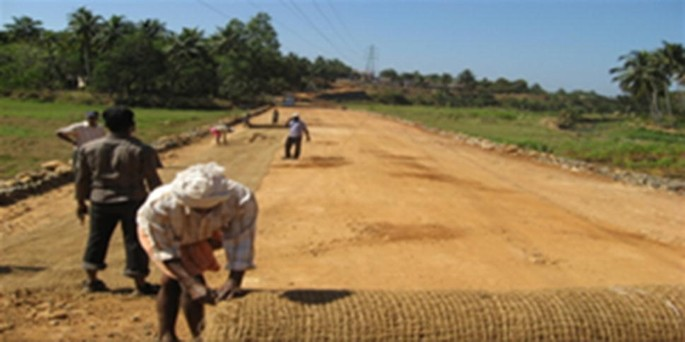
Coconut geotextile has been recognized as a good material for rural road construction under Pradhan Mantri Gram Sadak Yojana-III (PMGSY-III). As per these guidelines, 5% of the length of rural roads under PMGSY-III will be constructed using coir geotextiles. This decision opens up huge market potential and will be a boon to the Coir Council, which reports to the Ministry of MSME in the Central Government.
What are Coconut Geotextiles
Geotextile and subsequent use in civil engineerings, such as airports, road construction, support structures, etc. Soil is obtained by laying a geotextile on a tensile surface. Coastal features can be protected against storms, waves or floods with geotextiles in dune shields. Soil nails traditionally used for solid reinforcement are much more expensive, and geotextiles can be used for foundation reinforcement at a much lower cost.
Cultivation is permitted on steep slopes and when using geotextiles. This helps to further secure the ground. Fossil footprints of hominins may be due to weather conditions such as rain and erosion through the use of geotextiles. Melting glaciers, a major problem today, can also be solved by covering glaciers with geotextiles to protect them from the sun.
Maybe you like to read the following article Using Coir Geotextiles in Roads to Reinforce The Soil
Properties of coconut geotextile
Fibrous geotextiles are made from natural fibres, namely coconut fibres. Coir is a natural fiber made from the shell of the coconut. Fibrous geotextile is not affected by mold and moisture and does not rot. Microbial invasion should not affect the fibrous geotextile either. Since fibrous geotextiles are resistant to various types of damage, they do not need further chemical treatment. Therefore, it can also be considered an environmentally friendly fiber. This fabric will also last a long time and give us excellent durability.
The strength of fiber geotextile is also high, so fiber geotextile is popular in road construction. This fabric is porous, which means that water and moisture can move from the inner surface to the outer shell and vice versa. The surface of the soil is covered with fibrous geotextiles and promotes rapid growth of vegetation. This substance can be completely biodegradable, which means that it is easily broken down by microorganisms under natural conditions. So it is a medium in soil stabilization. The energy of running water can also be distributed through these fibers. Fibrous geotextiles absorb excess solar radiation.
Let’s Discover the Use of Fibrous Coir Geotextiles
Design and use of fiber geotextile form:
Fibrous geotextiles can be made using many methods and designs. The design of coconut geotextile solutions depends on the following factors.
- Design based on cost and availability
- Specification-based design
- Functional design
Here is The Application of Coconut Coir Geotextiles
UPSC coir geotextiles are permeable, strong and very durable; therefore, fiber geotextiles in road construction are considered an excellent choice, especially for rural areas. 5% of rural roads in India under PMGSY-III will be constructed with fiber geotextiles as per guidelines. Fibrous geotextiles protect the soil by absorbing excess sunlight and allowing moisture to penetrate. They also like low-growing plants.
Therefore, they are useful in agriculture. They also allow planting on steep slopes. Melting of glaciers due to global warming is a major problem today. Glaciers can be covered with fibrous geotextiles. They can absorb excess sunlight and to some extent prevent glaciers from melting.